Showing posts with label historical fiction. Show all posts

Thursday, August 25, 2016

RUBY LEE & ME

My Facebook feed is rife with back-to-school photos. Which makes this the perfect time to reflect on an era when enormous changes rolled across our educational system. During the late 1960's, racial integration of the public schools was finally being enforced.

In 1967 when Fall Creek Elementary in East Bend, NC became integrated, Shannon Hitchcock started first grade. 

Her school’s first African-American teacher taught her to read. Later, as an adult, Shannon learned Mrs. Porter was in poor health so she asked to visit. She wanted her teacher to know what an impact she'd made on her life. Mrs. Porter reminded her that white children had been uneasy about having a black teacher. To ease her students' concerns, she'd invited each of them to touch her face and hair. 

Shannon knew immediately that she wanted to write that story. The result is RUBY LEE & ME, inspired by her teacher, Mrs. Pauline Porter. 

RUBY LEE & ME is an authentic story of a 12 year-old white girl's struggles with guilt, loyalty, and circumstances that are beyond her control. Besides feeling responsible for her younger sister's accident, Sarah faces immense societal changes as her local school is forced to become racially integrated. She has a marvelous friendship with a black neighbor, Ruby Lee but school integration, which looms on the horizon, raises honest questions about how they will interact when their other friends are around. 

The uncertainty leads to misunderstandings, feelings of betrayal, and hurtful words.RUBY LEE & ME is tender, informative, impeccably written, and unflinchingly honest.

RUBY LEE & ME is a terrific addition to classroom reading lists and the learning experience will be enhanced with these Discussion Questions.  

Teachers and school librarians, you can enter the #MGGetsReal Giveaway that includes RUBY LEE & ME along with four other middle grade books covering tough topics. You'll find the contest widget at the bottom of the #MGGetsReal page. And do spread the word!


Monday, December 9, 2013

SEEING RED by Kathryn Erskine

First off, let me say, I'm giving away an Advanced Reader Copy of this book - unless of course, my generous nature kicks in and I decide to part with my gorgeous hardcover. The jury is still arguing over that. Either way you can't go wrong. So leave a comment AND share on social media to be entered in the contest. 

But first, the review.
SEEING RED is a disturbing book. There is the abusive neighbor and I've lived long enough to know he exists. There is the religious bigot and oh, yeah, I've met that one too. And then there is Red Porter, who in the midst of grief, does some things that go against his gentle nature.

Red's father is dead and he wants nothing more than to remain as close to him as possible.  For Red, that means keeping his father's auto repair shop open. He loves everything about it, the cars arriving outside (which he can identify just by the sound of the engine), the feel of the tools in his hand, and the smells of oil and tires.

From Page 2  I walked up the stairs in the back where Daddy had his office, taking in a deep breath of everything I loved. The shop was oil and gas and paint and dirt. It was brake pads, hoses, filters, and about any kind of tool you'd ever need to fix a car or truck. It was Lava soap, old rags, and a sink with a faucet you could turn on with just your elbow. It was the last place I saw Daddy.

I relate to the above quote from the book.  This was my Grandpop's shop/gas station in Plumsteadville, PA. The smell of tires, oil, and gas will always remind me of someone I loved.


Red clings to his Dad's garage but Mama wants to move on and, for her, that means selling the property and taking Red and his little brother to Ohio to live with her family. In some desperate attempts to thwart the sale, Red flirts dangerously with delinquent behaviors.

The property Mama wants to sell (house, store and car repair shop) border the property of the abusive/racist neighbor and tangled up in the mix is some vague history Red has heard about his family's property, the abusive Dunlop's property and an African-American church.  There's also some dispute over the property boundaries and the belief that more than one hundred years ago a Dunlop ancestor killed the black pastor of the church.

As Red thinks back over some scenes he'd witnessed between Daddy and Mr. Dunlop, those memories provide a puzzle with some pieces missing. But he's determined to find the pieces, assemble them, right some societal wrongs (his included), and maybe even hang on to his home place at the same time.

SEEING RED is truly readable. It's underlined with mystery, filled with action, and populated with rich and complicated relationships. And it doesn't hurt that Kathryn Erskine writes tough subjects with gently placed humor. There's some collective soul searching to explore here and fortunately, Scholastic has created a Common Core Discussion Guide designed for Grades 5 -9. .

The story is set in 1972 so, of course, America is going through a huge cultural shift.The most disturbing elements of SEEING RED have to do with racial relationships. In the Author Note, Erskine shares her passion for racial justice. As a child, she lived for awhile in South Africa surrounded by injustice and racial tension. Later she came to America and realized the painful truth that apartheid exists here too. As her mother explained it - "...we just don't call it that." 
   
Please check back this week, because I've snagged an interview with Kathy.  I might even go into a blogging frenzy and post 2 days in a row!

Here's the United Kingdom cover for SEEING RED.  Personally, I'm crazy about it!


Tuesday, October 15, 2013

WRITING BLOG TOUR Q & A

Linda Vigen Phillips tagged me on a Q & A blog tour – please hop over and read her blog. She’s got an incredible forthcoming verse novel!

My Q & A:

What are you working on right now?
A family saga have titled ROUNDABOUT.  (which means merry-go-round or carousel) The title is connected to a carousel theme within the book but also to the roundabout nature of my character's emotional journey. 
Me on my favorite roundabout in Ocean City, MD
How does Roundabout differ from other works in its genre?
I typically write historical fiction but this book is a hybrid.  My protagonist (Hilly) is a contemporary character on an emotional journey.  Via family keepsakes she discovers the stories of 5 ancestors. As she does this, her own story unfolds and the ancestor's stories add meaning to her own. So this one is historical fiction packaged within contemporary realism.

Why do you write what you do?

Because I can’t seem to help myself. I find history and want to tell it. I discover heartbreak and want to push into it. I have hope and want to share it.

How does your writing process work?

After I’ve bumped into that irresistible bit of history, I read and research all I can.  I imagine a character in that setting and think about conflict he or she will encounter.  I get a general outline in my head. Then I start writing.  

Although I do a lot of reading early on, I continue to research the whole time I’m writing. This involves interviews with experts, travel, museums, movies, food, and hours spent at microfilm machines with old newspaper accounts.  And riding merry-go-rounds, of course!

I write a section, read it back to myself and tweak it often as I go. (This is possibly a habit I should give up since a story benefits from momentum.) When the first draft is finished I give it to writer friends for feedback. I revise based on their critiques.  And then I repeat – sometimes giving it to different critics.  Occasionally I take my manuscript to a workshop for an editor’s in-depth critique.  Eventually I submit!

Any parting words of wisdom for other writers?

Immerse yourself in the writing community. Swap critiques with your writer friends. Revise based on their criticism. Eat dark chocolate and exercise!  

Monday, April 16, 2012

ON WRITING HISTORY IN FREE VERSE (May B. & Caroline Starr Rose)

My friend, Augusta Scattergood, just posted a terrific interview with Caroline Starr Rose, author of May B.


I found this both fascinating and informative since I'm also writing a novel in free verse.  I loved hearing how organic Caroline is being with the writing. I suspect this is necessary because poetry is such an organic thing anyway.

As I dig back into my work-in-progress I realize my earlier attempts were stiff because they grew out of my concern for plot. This time I am focusing more on the characters - digging into their souls and letting them speak from deep longing, profound joy, and whatever other emotions bubble up.

Imagine the emotions in this story...


I haven't read May B. Yet. But reading the interview and seeing this trailer makes me want to. So, Kansas prairie - here I come...

Do head on over to Augusta's blog to read the interview with Caroline! Leave a comment and you could win a copy of the book!  Wish I could win but I'm not entering because I just won another book at Augusta's blog and well, it's your turn!. 

Augusta Scattergood is the author of Glory Be. (Interesting title parallels going on here, eh?)

Thursday, July 21, 2011

Book Review: THE FRIENDSHIP DOLL by Kirby Larson

I'm always pleased when Augusta Scattergood drops a book review into my inbox.  And thank goodness, she's done it again! 

THE FRIENDSHIP DOLL
By Kirby Larson (Delacorte Press, 2011)
208 Pages
Ages: 9-12

In 1927, 58 dolls were sent from Japan to the United States as Ambassadors of Friendship. About three feet tall, their black human hair was cut in a bob, their faces hand-painted. They were dressed in silk and possessed lacquer chests, tea sets, and parasols. A young girl’s dream.

The dolls traveled around the country until Pearl Harbor, December 1941, when most were removed from display.

Based on her research into these doll ambassadors, Kirby Larson, author of another of my favorite historical fiction novels, HATTIE BIG SKY, has just published a terrific new book for kids, THE FRIENDSHIP DOLL.

Told chronologically in ever-worsening situations, beginning in 1927 and ending in present-day Seattle, four girls with strong, distinct voices, relate to a single Japanese doll. Woven together by the presence of the doll, any of the chapters could be read aloud as a stand-alone. The stories are harsh, moving, uplifting, funny—and page-turning.

The doll star of this show is Miss Kanagawa. She’s special, and yes, she interacts with some of the human characters in the book. But she’s not a toy who comes awake at night to dance in the playroom. Not a chance. She’s considerably more subtle and sophisticated than that. She communicates with interwoven snippets, imagined eye movements. She feels a slight twinge, a pain in her heart here and there.

As the story unfolds, Miss Kanagawa begins to understand what is happening:

 I sit on the shelf, watching the seamstress mend my kimono. It seems I am being prepared for something, but I do not know what that is.

There is a new feeling in my heart—how strange and yet how sweet to say that word…like there is a string tied to my heart, as if it is a kite being tugged by a kite flier whose face I cannot see.

Yet.

A quasi debate about the nature of historical fiction has turned up on blogs and websites. Is it historical if it’s just set in the past— with appropriate details, characters, language— yet not related to an actual event? Is it historical fiction if it was written as contemporary fiction but now read by young readers 30 years later, who see anything before they were alive as the past?

I’m not re-opening that particular worm can right now. But I would like to go on record: This book represents all the best in historical fiction for young readers. Real history and facts—the kind you find in textbooks, reference books, and on scholarly websites. Through terrific books written of another time and other places, kids experience history in context (the food –lots of beans during the Depression, the clothing, the actual words spoken).

That’s what I love about THE FRIENDSHIP DOLL. It’s based on research and real facts, and it’s a great story, well-told in a way that makes the period jump off the page, in a good way. And there’s so much history! The Chicago World’s Fair, the Okies traveling Route 66, Eleanor Roosevelt.

The Author’s Note at the end breaks down the different stories and offers a glimpse into Kirby Larson’s extensive research and contagious enthusiasm for this project. I want to know more, or at the very least, read the novel again from start to finish.

This book was sent to me by the publisher. Whether or not, they knew I was once a child hoarder collector of dolls (often snatched from the arms of my younger sister), I can’t say. But that’s not really what THE FRIENDSHIP DOLL is about. Yes, there is a doll. No, it’s not the only thing to love about the book.


For additional information and resources, check out Kirby Larson’s website.
http://www.kirbylarson.com/books/the-friendship-doll/

And check out this article on the Seattle’s Child website.
http://www.seattleschild.com/article/the-friendship-doll-has-a-voice-of-its-own


Augusta Scattergood
Reviewed by Augusta Scattergood

GLORY BE, Augusta’s first novel, is historical fiction set in 1964 Mississippi. It will be available in January, 2012, from Scholastic. You can follow her progress on her own blog: http://ascattergood.blogspot.com/

Click on over and check out GLORY BE's stunning cover as well as Augusta's thought provoking reflections, book news, and reviews.

Thank you, once again, Augusta! I'll definitely be reading The Friendship Doll!

Monday, May 16, 2011

Interview with Newbery Award-winning CLARE VANDERPOOL

As promised on Friday, Augusta Scattergood, who reviewed Moon Over Manifest for us, is back with an interview from the the author, Clare Vanderpool!


Thank you, Clare Vanderpool, for agreeing to speak to us here at THE 3 R's: READING, 'RITING & RESEARCH.

Congratulations on the amazing award. Your fellow lovers, writers and readers of historical fiction are very proud!

Can you share some of the books that made you fall in love with reading when you were young? The books you read so intently that you walked into those telephone poles? And we love this image because we’ve all been there!

A Wrinkle in Time, Island of the Blue Dolphins, Little House on the Prairie, Anne of Green Gables, Charlotte’s Web, Half Magic. These are all great books for walking into telephone poles… so be careful!

I noticed from your book jacket bio that you enjoy reading historical fiction. Are there books in the genre you’ve read recently that you particularly loved?

I recently read Turtle in Paradise by Jennifer Holm. And a while back I read Crows and Cards by Joseph Helgerson. This was kind of a Tom Sawyer, river boat story. I also loved Richard Peck’s A Long Way from Chicago and A Year Down Yonder.

Was there a part of Moon Over Manifest that drove the writer in you crazy? For example, anything big that got left out of the book in the end, or ended up being your favorite part after much writer hair-pulling?

Nothing really drove me crazy, but sometimes it seemed like I’d never really finish the book. The story was just so layered that I went back through it many times to make sure the different characters’ voices were consistent, that my timeline was accurate, that the various threads of the story pulled together in the end. I created a master checklist that listed every chapter, Hattie Mae column, letter from Ned, etc. and would use that same checklist over and each time I went back through the manuscript. I also used lots of post-it notes to mark places that I needed to come back to and add little brushstrokes or bits of information to the story. Every little detail mattered. It was a great relief to me when there were no more post-it notes stuck throughout the pages.

What drew you to this particular place and especially these two time periods-1936 and 1917?

I’m a very nostalgic person and I like imagining myself in another place and time. The town of Manifest is based on the real town of Frontenac , Kansas. My mother’s parents are from that area in southeast Kansas. As I did the research for the story, I learned how rich and colorful the history was in that part of the state. And there seemed to be a natural connection between 1936 and 1917. During hard times (like the Depression), I think people tend to harken back to a time they remember to be simpler and happier. Both time periods had plenty of difficult things going on. Drought and economic crisis in 1936. World War I and the Spanish Influenza in 1917-18. So there was plenty of history to draw from for both storylines.
Since many of our blog readers read and/ or write historical fiction, do you have any great tips to share about your writing process or your research techniques?

I love doing research. As I said, I’m a very nostalgic person and I love delving into the past. Newspapers, yearbooks, graveyards, the History Channel. These are all great avenues for learning about other times and places. I spent a lot of time looking at microfilm in the library of old newspapers from 1936 and 1918. This can add a lot of authenticity and flavor to a historical novel. And it’s fun!

(Joyce here)  Thanks Augusta, for coming bringing Clare to The 3 Rs!

And thank you, Clare for taking time from a truly busy schedule to grant this interview. I loved reading your update to your website - the one that explains a bit of life after winning the Newbery.  I've often wondered how one copes with the aftermath of winning a major award.  Now I know - with a healthy dose of humor! 

For more from Augusta Scattergood, visit her blog at http://ascattergood.blogspot.com/ .

Monday, December 27, 2010

AFTER THE TRAIN: Putting the story back into history

Recently, while I was checking out books on Germany at the library, the patron beside me mentioned a failed plot to kill Hitler. I knew that someone had carried a briefcase with a bomb into a meeting but neither of us could remember the would-be assasins's name.

Fast-forward one week:

I go back to the library for more books on Germany and come home with AFTER THE TRAIN, middle grade historical fiction by Gloria Whelan. 

I am reading along in this story when suddenly, Claus von Stauffenburg, the would-be Hitler assassin enters the plot.

Not in person, of course, because Hitler ordered him executed immediately and because After the Train takes place in 1955. Germany is trying to recover from WWII. Thirteen year old Peter Liebig remembers nothing about the war but his school teacher wants the class to learn from Germany's response to Hitler.


Herr Schmidt says ,"In spite of the things that happened during the war, there were Germans who risked their lives to oppose Hitler.  I want you to find such a person and write that person's story."

Peter talks to his father, an architect who was drafted to build barracks for Hitler's troops. Father struggles with shame but he also tells Peter he did one thing that he's proud of. He leaves Peter in suspense about what that was, unwittingly sending him on a quest to find out.

Father tells Peter about Claus Von Stauffenburg, the Nazi army official who tried, but failed, to kill Hitler.  Suddenly both Peter and I are engrossed in this piece of history. I rush to the internet where I get a refresher history lesson on Stauffenburg. Peter sneaks to his mother's dresser drawer and a stack of old letters where he discovers a secret his parents have kept from him. 

Peter also becomes friends with Herr Schafer, a Jewish bricklayer who's helping Peter's father rebuild St. Mary's Church.  Herr Schafer helps Peter understand the war's complexities in ways that Peter's parents cannot.

Remember my convo with the stranger at the library?  I'd love to bump into her again, hand her this novel, and say, "We should be reading more historical fiction for young people".

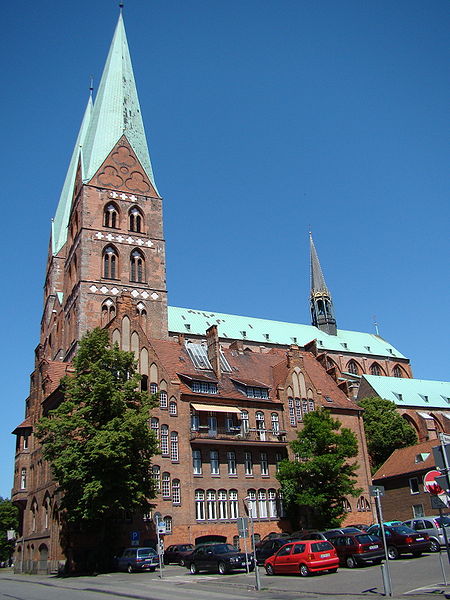
And now to St. Mary's church. 
Attribution: Bundesarchiv, Bild 146-2005-0054 / Unknown / CC-BY- shared under Creative Commons Guidelines.
 Here's a picture of it after the war.


Photo by Arnold Paul shared under Creative Commons guidelines
Here's the restored version of St. Mary's Church.


And for a breath-taking view of the church's interior, check out this video!


Thank to Dave's Been Here for that! And to Gloria Whelan for putting the story back into history!

Tuesday, November 9, 2010

Look At This Book: SELLING HOPE

So here's a brand spanking new historical novel that I want to read. I mean really - could you walk away from this face or this title?

Nuh, uh!

And you don't have to because Selling Hope, which has already earned its first starred review, is on bookshelves today!

About the book:

It’s May 1910, and Halley’s Comet is due to pass thru the Earth’s atmosphere. And thirteen-year-old Hope McDaniels and her father are due to pass through their hometown of Chicago with their ragtag vaudeville troupe. Hope wants out of vaudeville, and longs for a “normal” life—or as normal as life can be without her mother, who died five years before. Hope sees an opportunity: She invents “anti-comet” pills to sell to the working-class customers desperate for protection. Soon, she’s joined by a fellow troupe member, young Buster Keaton, and the two of them start to make good money. And just when Hope thinks she has all the answers, she has to decide: What is family? Where is home?

You can meet author Kristin O'Donnell Tubb at her website or her blog.

If you're due to pass through one of the following locations in the next few months, you can meet Kristin in person!

Sat, Nov. 13 at Cool Springs Barnes & Noble, Franklin, TN, 2 – 4 p.m.
Sat, Nov. 20 at Malaprop’s Bookstore, Asheville, NC, 3 – 5 p.m.
Wed, Nov. 24 at E.G. Fisher Public Library, Athens, TN, 2 – 4 p.m.
Sat, Dec. 4 at Davis-Kidd Bookstore, Nashville, TN, 2 – 4 p.m.
Thurs, Feb. 10 at Anderson’s Bookshop in Naperville, IL, time TBD

Malaprops Bookstore in Asheville - hmmmm - bet I could arrange to be passing through.

Monday, March 29, 2010

AN "INTERVIEW" WITH CAROL BALDWIN

Me with my guest blogger, Carol Baldwin

See there in the sidebar – the call for guest bloggers – Carol Baldwin took me up on it. Carol is author of Teaching the Story.  She and I give workshops together and also swap manuscripts for critique. Lately she’s been having conversations with me in her head. So she wanted to share them with you on my blog!  Keep in mind that these are questions she posed herself - imagining what I would ask her! 

Why did you want to be a guest blogger here?

I loved the fact that you used the Yiddish word, “Maven” to describe the experts you were looking for. I remembered that word from my Jewish upbringing. That was the first thing that hooked me—you don’t see too many “Goyim” use it!

Even though I’m not an expert yet, I thought your readers might enjoy hearing about some of the experiences a writer goes through as she is writes her first historical novel.

Why did you decide to write historical fiction?

Carol: I love reading well-written historical fiction. I think it entertains and educates at the same time. My children were drawn to it too; they always wanted to know if what they were reading was a “real” story.

Your story takes place in Charlotte, NC in 1950. How did you come up with the plot idea?

Joyce I think you blogged about writing the story in “your own backyard.” Over ten years ago I visited Wing Haven, a garden and bird sanctuary that was started in the 20’s by Elizabeth Clarkson. I thought, someone should write a picture book about this place. I tried to do that but there were too many stories to be squeezed into a picture book. Then I tired incorporating a real event, about how Mrs. Clarkson rehabilitated a robin and put it on a plane to Florida, into a book for young boys. That didn’t work. Then I started playing with some of the characters and thinking about some conflicts that could have been going on in Charlotte at that time. Since it is just before integration, I knew that should be part of the picture. Also, Wing Haven is in the heart of Myers Park, a very fashionable place to live. I started imagining some class issues that could have taken place if a young girl moved into Myers Park who felt as if she didn’t belong there. Each part of the story was built on brainstorming the characters, their setting, and their histories.

Tell us about your experience. What have been some of the high points for you?

Without a doubt interviewing people who lived in Charlotte around that time period. I love stories and I have heard many.

Can you share one or two that will find their way into your story?

Carol: The very first African Americans I interviewed were two men who grew up very near Myers Park. (By the way, I actually interviewed them sitting inside a Rosenwald school. I really wanted to use that school in my story since it’s a “real” place that still exists, but as it turns out it’s not the exact location where my black character would have gone to school.) Casually one of the men mentioned that his grandmother’s grave had to be dug up to make room for new houses. When the grave was opened, they had found she was buried with a tea cup. That intrigued me and became an important point in my story. Another African American shared how he was beaten by the police as a teenager because he was with a light-skinned girl; they accused him of being with a white girl. I met several people who graduated from Central High School in 1950. They continue to be a great resource for everything from slang, to clothing, to music and hobbies.

 How about low points. What has been difficult for you?

 The whole process is overwhelming. The amount of data that I find and need to keep track of boggles my mind. For example, I just googled “Central High School” and found two new links to information and photos about schools in Charlotte at the time period. Research is both fun and frustrating. There feels like there is no end!

Any other comments you would like to make to my readers?

When you read a piece of historical fiction keep in mind that the author has worked hard at making the story authentic. And wish me luck as I plug away at mine.

Good luck, Carol! (from Joyce - for real this time!)

 (And BTW - I had no idea Maven was yiddish.  I just learned that word from playing Scrabble.) 

MORE Q & A WITH MIDDLE SCHOOLERS FROM H.H. POOLE

Oneof these books is not about a disease.  Do you know which one?

1. Why do you write about diseases?

This is multiple choice. There could be more than one right answer. And no, you don’t want me to be your doctor.

A. I am a sick person.
B. I should have been a doctor.
C. I  probably have a fear of getting sick.
D. I am fascinated with the emotional aspects of illness and the way it changes people’s lives.

2. Who’s your favorite character in your books?
  • Well, in every book, I’m always attached to my main characters.
  • I think Imogene Wilfong in Blue is very cool.
  • But I also happen to love Junior Bledsoe in Blue and especially in Comfort! He’s a very hot item you know. One of my readers sent me an email saying if her husband ever divorced her she was going to drive to North Carolina and track Junior Bledsoe down!
3. How did you get ideas for your stories?

There are so many fascinating hidden stories in history. When I'm working on one project I discover some story that grabs me by the heart and tries to drag me away with it. Usually I force myself to ignore it until I finish the project I’m on. But in the back of my brain a story begins to take shape and as quick as I can I go after it!

Example:  I was writing Vacation Bible School curriculum when I discovered Father Damien. I only needed a short story about leprosy for the curriculum.  But the research led me to more info and I wanted to do something longer with it. So I eventually wrote and published Healing Water, about a boy who is banished to Hawaii's leprosy settlement on the Kalaupapa Peninsula. He meets Father Damien there.
On the Kalaupapa Peninsula.

4. What was it like to go to Kalaupapa? 
I had to hike down a steep trail for a few miles. That was challenging. I had to hike back up. That was hard. The next day my legs hurt so badly I could barely walk.

Being there was cool but also a little bit frustrating because I wanted to roam freely and spend lots of time alone, getting to know the landscape and thinking about my story and my characters. But I had to stick to the guided tour and of course, there were other people around. I understand why people like me can’t just roam freely in this very private place but still, I wanted to.

Thursday, February 11, 2010

Q & A WITH MIDDLE SCHOOL STUDENTS AT VOYAGER ACADEMY

Photo courtesy of Voyager Academy Website.

Back in September I met Jenny Murray at a SCBWI Carolinas writing conference. Jenny is the curriculum director at Voyager Academy where she recently read BLUE with some of her middle school students.

The students - Alexis, Darith, Caroline, Courtney and Jake - tossed a few questions my way. I decided to answer them here.

1. What inspired you to write this book? (Blue)

Homework! I signed up for a history writing workshop and before I even went to the class, the instructor gave me an assignment to research a local story. So I called our history museum to get some ideas. I discovered that in 1944 North Carolina had a polio epidemic and that Hickory (with help from March of Dimes, Red Cross etc) had put together an emergency hospital in just 3 days. I started reading about that and the drama of people's lives being changed by polio, grabbed me.

2. Do you plan to continue to write about diseases?

Why do you want to know? Do you think I'm a little obsessed?

Hmmmm. Maybe, I am. My next book takes place in a mental hospital - so that kind of fits the pattern, doesn't it? I might actually be moving away from diseases. But I think my books will always be about tragedy and compassion. Not sure why, but some stories of pain grab me and make me tell them. Stories can be very demanding that way.

3. Do you plan to always write historical fiction?

Probably. But it doesn't matter what I plan, really. I sometimes think I'm going to write one thing and then, another story comes after me.

I actually began writing contemporary stories but I wasn't finding a publisher for them. Then I discovered Father Damien and the story of Hawaii's leprosy settlement and I got caught up in researching it. I was completely hooked. (So, although Healing Water was published after Blue, it was the one that helped me to realize that I'm a history writer.)

Now I know that history is my niche and that research is a never-ending adventure which I thoroughly enjoy. Hidden stories from the past are begging someone to tell them. Might as well be me.

I will tell you, though - that the book I'm working on now, actually has both a contemporary plot line and a historical one. So, see - I'm not all about dead people!

Thank for the questions!

Tuesday, January 26, 2010

Teaser Tuesday With a Twist: BILLY CREEKMORE


TEASER TUESDAY WITH A TWIST

(rules for myself)
  1. Grab a history book
  2. Find a passage I love
  3. Share a few teaser sentences

I read and loved Billy Creekmore, a few years ago. This, from the back of the book, explains why:

I am a motherless child,

a thief,

a saint,

a sinner.

I am a storyteller,

a coal miner,

a circus star,

a con artist,

a seer, and a liar.

I am a friend,

a hero,

a survivor.

I am Billy Creekmore.

Now doesn't Billy sound like someone you want to meet?

You can meet author Tracey Porter at the Harper Collins website.

BTW - Billy Creekmore made Oprah's Kids Reading List which means it also earns my Lil' Green Book Award. (it's all about professional jealousy!)

Saturday, January 16, 2010

Q & A WITH MIDDLE SCHOOLERS FROM VOYAGER ACADEMY

Photo courtesy of Voyager Academy Website.

Back in September I met Jenny Murray at a SCBWI Carolinas writing conference. Jenny is the curriculum director at Voyager Academy where she recently read BLUE with some of her middle school students.

The students - Alexis, Darith, Caroline, Courtney and Jake - tossed a few questions my way. I decided to answer them here.

1. What inspired you to write this book? (Blue)

Homework! I signed up for a history writing workshop and before I even went to the class, the instructor gave me an assignment to research a local story. So I called our history museum to get some ideas. I discovered that in 1944 North Carolina had a polio epidemic and that Hickory (with help from March of Dimes, Red Cross etc) had put together an emergency hospital in just 3 days. I started reading about that and the drama of people's lives being changed by polio, grabbed me.

2. Do you plan to continue to write about diseases?

Why do you want to know? Do you think I'm a little obsessed?

Hmmmm. Maybe, I am. My next book takes place in a mental hospital - so that kind of fits the pattern, doesn't it? I might actually be moving away from diseases. But I think my books will always be about tragedy and compassion. Not sure why, but some stories of pain grab me and make me tell them. Stories can be very demanding that way.

3. Do you plan to always write historical fiction?

Probably. But it doesn't matter what I plan, really. I sometimes think I'm going to write one thing and then, another story comes after me.

I actually began writing contemporary stories but I wasn't finding a publisher for them. Then I discovered Father Damien and the story of Hawaii's leprosy settlement and I got caught up in researching it. I was completely hooked. (So, although Healing Water was published after Blue, it was the one that helped me to realize that I'm a history writer.)

Now I know that history is my niche and that research is a never-ending adventure which I thoroughly enjoy. Hidden stories from the past are begging someone to tell them. Might as well be me.

I will tell you, though - that the book I'm working on now, actually has both a contemporary plot line and a historical one. So, see - I'm not all about dead people!

Thank for the questions!

Wednesday, December 30, 2009

COME JANUARY, THIS BLOG IS HISTORY!

ABC-CLIO: Your Complete Source for History Reference.


The 3 R’s are not dropping off into outer cyberspace. But still, they’re about to become history. Starting in January, the content will be largely historically focused.


I’ll include interviews with:

  • Folks who write history.
  • People who’ve made history.
  • Archivists who preserve history.


And I’m really happy to announce that there will be a regular (or regularISH) Q & A With Carolyn Yoder, my editor who knows way more about reading, writing, and researching history than I do!


Just so you know, I’m not strong at creating structure or sticking to it. So, in all likelihood, the info here will be totally random. Sort of one big smorgasbord of historical delicacies!


A few things you'll find at the buffet:

· Book reviews of historical fiction and non

· Interviews with history writers

· Links to history websites

· Classroom ideas from history teachers

· Research tips

· This day in history

·And the price of eggs in 1944


The way I figure it, history is an endless smorgasbord. Which means my blog ideas are infinite! So, even though structure is not my strong suit, I'll create some categories that allow for topical searches.


And if there's something you'd like to see here, by all means, speak up! I'll do my best to hunt down the info and serve it up in a palatable manner.

Monday, June 8, 2009

D-DAY DELAYED POST

Larry Mosteller is my antique car expert. He's restoring this one. Chuck and I loved hanging out with him and Kay and their classic car club.

I was thinking, on Saturday, that I should be writing a D-Day Post but I was busy gallivanting around in a 1934 Chrysler instead. And visiting the Miracle of Hickory Exhibit and eating BBQ! (The way it ought to be eaten!)

So now, two days, later I shall play "catch up with the times".

We've heard the D-Day story so often. I saw a great piece on World News Tonight about young folks going with WWII vets back to Normandy to hear their stories and provide emotional and physical support. (Fabulous!)

But rarely do we get to glimpse the D-Day invasion from the eyes of a young French girl. Recently however, I've had the extraordinary privilege of reading a middle grade manuscript by a local writer who is telling such a story.

Such a story, indeed. This is the sort of story that practically tells itself.

Unfortunately it's never that easy! The writer has to actually compose, revise, revise, and revise. And what about some more revisions?

But really, all the elements of plot are built into this historical event. Not just the elements - but the symbolism, the human drama, the tender touching relationships between American soldiers and French peasants.

This is the sort of story that makes me wish I had discovered it. Except that it required multiple trips to France and researching through an interpreter.

I could do that, of course. But would I?

I love that Eric Groce did. And I'm thrilled he included me in the reading and critiquing process. I'll be doing the happy dance when I see it in print.

Wednesday, May 6, 2009

WRITING WEDNESDAY: My POV Character

For more than a year, I've researched my work-in-progress. And occasionally, I would actually write in it! Especially when a grant application required it. (The possibility of money can motivate even me to outline!)

So I researched. I outlined (excruciating process!) I wrote 9 chapters as well as various letters and diary entries. I was moving along quite well. But there were nagging problems related to the age of my character and historical authenticity.

When friends asked me what I was writing, I usually told them about the historical events behind my story. But I had trouble articulating who my character was and how I was going to get this story out to a YA audience.

At one point I blogged about how I found my character's voice. And I wasn't entirely mistaken about that. But, truth be told, I still had issues. I just didn't realize it yet.

Months passed in which I researched, stayed busy with author events, learned to tweet, picked at hangnails, and contemplated my point-of-view character.

And now, finally, I'm catching on! There will be several POVs. This is not a writing device that I love to read because I think it's hard to do well. But I am up for the challenge!

I love both of my POVs. I have lots to learn about the newer one. But meeting people is fun. Especially when I'm at home alone!

Saturday, March 28, 2009

SUPERB SATURDAY! Books and Writer Friends

1. COMFORT arrives in the Port of New York today. Hopefully it will be offloaded quickly and sent on its merry way to the publisher's warehouse and from there to my doorstep and also to yours. It's a little late coming in but back orders will be filled the day they arrive in the warehouse.

Regarding COMFORT, I discovered (and plagiarized) the following paragraph from the blog of J.L. Powers, "author, historian of Africa, and small publisher".

I just wanted to give a quick shoutout for the latest batch of y.a. books from Front Street Press. I will be reviewing them for New Pages, but wanted to say I’ve been thoroughly enjoying their offerings: Morning in a Different Place by Mary Ann McGuigan, Markus and the Girls by Klaus Hagerup, and Comfort by Joyce Moyer Hostetter are all the kinds of novels that make me proud to write for young adults.

Thank you, J.L. Powers!

2. Mary Ann Scott, who is enroute to her new home in GA is here with adorable daughter, Maisie and their two dogs. I met Mary Ann a few years ago when I spoke at the Fall Philly Conference of SCBWI Eastern PA Chapter. She's one amazing lady - moving with family this week and going back north next weekend for the Eastern PA Pocono Retreat Conference, which BTW, she also organized!
It's been great talking books and writing habits and research with her!
Daisie and Whitman hung onto our every word. Okay, so Daisy took a nap. Who knew that not everyone loves historical fiction?!

3. It's rainy here so I am cozying up with a WWII/D-Day manuscript written by a friend. Critical eye, honest feedback, encouragement, and all that! Time for another cup of coffee.

Wednesday, December 24, 2008

JUST GIVE ME THE PLOT! (PLEASE)


Plotting is not my strength. After all, it's largely about conflict and I'm not a conflict-escalating sort of person. (My husband may beg to differ but, thankfully, he doesn't comment on my blogs.)

What I've discovered in the course of writing, Blue, Healing Water, and Comfort is that history does the plotting for me. The elements of my story are all embedded in the past. I simply have to unearth them.

But researching history requires travel, money, and time.

Ah, time. I am, at this moment, waiting impatiently for a treasure trove of information to arrive in my mailbox. It's a memoir with details that will inform my newest plot. I've been holding back, thinking there's no use writing until I have this amazing piece of work in my hands. (I read a small portion of it already. I know how incredible it is!)

But it's taking a long time to get here and I need to get on with the writing.

The truth is, I've done the basic research. I probably have enough information to actually plot my story. Certainly the details in that memoir will add additional layers, but for now I should probably just take what I've learned and get on with it.

Therefore, I'm slogging through an outline. Escalating the conflict as I go.

Very stressful, indeed!

Wednesday, December 3, 2008

THE PROTAGONIST'S VOICE

For the last month, I've been writing the first draft of my work-in-progress. And finally, yesterday I found my character's voice.

Major breakthrough!

Voice is a hard thing to pin down - in some ways it simply means an author's unique way of expressing herself. But it also means the character's way of expressing himself. Since I write historical fiction, my character's voice must also match the time and place in which he lived.

And of course, a youth of the 1940's (and a religious one at that) might not have appeal to today's kids who live in an edgy world.

So I've been wondering how I was going to meet the challenge of creating a credible character. This week I figured it out. I finally realized how I can tell this story in a way that is true to my character while still holding appeal for contemporary young adults.

At least I think I have. In some ways this isn't so much about sentence structure, idioms or personality as it is, presentation.

I've discovered a format that will allow for the 1940's voice to feel relevant. Yay! After a month of trudging through the dark, writing the story just became so much clearer and way more fun!

Tuesday, August 12, 2008

THINGS I INHERITED: NAOMI'S GARDEN


A few weeks ago my 3 sisters and I visited an old friend - a lovely woman from our childhood. I hadn't seen her in decades and I wanted to freeze the moment. So I snapped pictures until she threatened to confiscate my camera. At that point I put it down and just soaked up the sight of her.

Ah, she is a beauty! I'd love to post her pic but I didn't ask permission. Instead I'll share these images of her garden. Understand - Naomi lives in a retirement center in a 3rd floor apartment. But do you think that stops her from having a garden? Those tomatoes are growing on her 6'x 6'deck.

And what are fresh garden tomatoes without corn--on-the-cob?

This resourceful lady is not related to me and yet she is part and parcel of all the good things I inherited - rural life, homecooked meals, a deep faith, and a close-knit church community!

I suppose Naomi explains, to some degree, why I write historical fiction. I don't actually want to go back to the past (because how could I live without my computer and the virtual life it harbors?).

But there is a grounding in history that nurtures me. And I love slipping back a few decades to soak up the values I learned there.