SCBWI (Society of Book Writers and Illustrators) is an international organization that provides support, training, and relationships for those of us who want to produce literature for young people.
There are lots of reasons to participate, including grants and awards!
Each year The Amber Brown Grant, in honor of Paula Danziger is awarded to 2 schools demonstrating interest and need. It provides funds for an author or illustrator to visit winning schools to spend time with students.
This year one of the 2 winning schools is Eastover Central Elementary School in Fayetteville, NC. And the author they chose to visit is me. Yay! How exciting is that?
As I understand it, Eastover Central will be given several hundred dollars worth of my books, author visit expanses will be covered, and we'll all enjoy a pizza party. Thank you, SCBWI and to Gee Cee Addison for working out the details.
We're planning the visit for late April - should be a great time to travel.

Showing posts with label Be thankful for the good things that you've got. Joyce Moyer Hostetter. Show all posts
Showing posts with label Be thankful for the good things that you've got. Joyce Moyer Hostetter. Show all posts
Thursday, January 19, 2012


Tuesday, October 19, 2010
THE LITTLE READ IN CALDWELL COUNTY
This week I get to spend two whole days in nearby Caldwell County. I'll be speaking to 4th graders about BLUE and the 1944 polio epidemic. Here are a few pics of my Caldwell experience last spring.
 I do have fabulous pictures of some of the students I spoke to but I don't have permission to post all those kids on the web so I will let this lovely sculpture from the county office represent the 4th graders.


I got to hang out with Media Specialists and school board members over lunch.

At Baton Elementary, Linda Andrews went all out with a polio and BLUE related display.


After school, 2 media specialists, Annamarie Stuckey and Susan McFarland took me on an outing.
It was just my sort of adventure -

winding country roads which led to a historical spot.
Now the site belongs to a riding club. But...

Before economics forced a change, it was the site of 4-H Camp

The land was donated by a Caldwell County school principal, Luther Robinson, whose daughters got polio during the 1953 epidemic in Caldwell County. He wrote his heartbreaking but inspiring story in We Made Peace With Polio.

Many others in Caldwell County were affected by polio that year. So my visit is not just about BLUE and the 1944 epidemic. It's about the history of the students and their families. It's an honor to explore history with students in Caldwell County and I'm grateful to the Educational Foundation for sponsoring my visit!
Monday, March 29, 2010
AN "INTERVIEW" WITH CAROL BALDWIN

Me with my guest blogger, Carol Baldwin
See there in the sidebar – the call for guest bloggers – Carol Baldwin took me up on it. Carol is author of Teaching the Story. She and I give workshops together and also swap manuscripts for critique. Lately she’s been having conversations with me in her head. So she wanted to share them with you on my blog! Keep in mind that these are questions she posed herself - imagining what I would ask her!
Why did you want to be a guest blogger here?
I loved the fact that you used the Yiddish word, “Maven” to describe the experts you were looking for. I remembered that word from my Jewish upbringing. That was the first thing that hooked me—you don’t see too many “Goyim” use it!
Even though I’m not an expert yet, I thought your readers might enjoy hearing about some of the experiences a writer goes through as she is writes her first historical novel.
Why did you decide to write historical fiction?
Carol: I love reading well-written historical fiction. I think it entertains and educates at the same time. My children were drawn to it too; they always wanted to know if what they were reading was a “real” story.
Your story takes place in Charlotte, NC in 1950. How did you come up with the plot idea?
Joyce I think you blogged about writing the story in “your own backyard.” Over ten years ago I visited Wing Haven, a garden and bird sanctuary that was started in the 20’s by Elizabeth Clarkson. I thought, someone should write a picture book about this place. I tried to do that but there were too many stories to be squeezed into a picture book. Then I tired incorporating a real event, about how Mrs. Clarkson rehabilitated a robin and put it on a plane to Florida, into a book for young boys. That didn’t work. Then I started playing with some of the characters and thinking about some conflicts that could have been going on in Charlotte at that time. Since it is just before integration, I knew that should be part of the picture. Also, Wing Haven is in the heart of Myers Park, a very fashionable place to live. I started imagining some class issues that could have taken place if a young girl moved into Myers Park who felt as if she didn’t belong there. Each part of the story was built on brainstorming the characters, their setting, and their histories.
Tell us about your experience. What have been some of the high points for you?
Without a doubt interviewing people who lived in Charlotte around that time period. I love stories and I have heard many.
Can you share one or two that will find their way into your story?
Carol: The very first African Americans I interviewed were two men who grew up very near Myers Park. (By the way, I actually interviewed them sitting inside a Rosenwald school. I really wanted to use that school in my story since it’s a “real” place that still exists, but as it turns out it’s not the exact location where my black character would have gone to school.) Casually one of the men mentioned that his grandmother’s grave had to be dug up to make room for new houses. When the grave was opened, they had found she was buried with a tea cup. That intrigued me and became an important point in my story. Another African American shared how he was beaten by the police as a teenager because he was with a light-skinned girl; they accused him of being with a white girl. I met several people who graduated from Central High School in 1950. They continue to be a great resource for everything from slang, to clothing, to music and hobbies.
How about low points. What has been difficult for you?
The whole process is overwhelming. The amount of data that I find and need to keep track of boggles my mind. For example, I just googled “Central High School” and found two new links to information and photos about schools in Charlotte at the time period. Research is both fun and frustrating. There feels like there is no end!
Any other comments you would like to make to my readers?
When you read a piece of historical fiction keep in mind that the author has worked hard at making the story authentic. And wish me luck as I plug away at mine.
Good luck, Carol! (from Joyce - for real this time!)
(And BTW - I had no idea Maven was yiddish. I just learned that word from playing Scrabble.)
MORE Q & A WITH MIDDLE SCHOOLERS FROM H.H. POOLE

Oneof these books is not about a disease. Do you know which one?
1. Why do you write about diseases?
This is multiple choice. There could be more than one right answer. And no, you don’t want me to be your doctor.
A. I am a sick person.
B. I should have been a doctor.
C. I probably have a fear of getting sick.
D. I am fascinated with the emotional aspects of illness and the way it changes people’s lives.
2. Who’s your favorite character in your books?
- Well, in every book, I’m always attached to my main characters.
- I think Imogene Wilfong in Blue is very cool.
- But I also happen to love Junior Bledsoe in Blue and especially in Comfort! He’s a very hot item you know. One of my readers sent me an email saying if her husband ever divorced her she was going to drive to North Carolina and track Junior Bledsoe down!
There are so many fascinating hidden stories in history. When I'm working on one project I discover some story that grabs me by the heart and tries to drag me away with it. Usually I force myself to ignore it until I finish the project I’m on. But in the back of my brain a story begins to take shape and as quick as I can I go after it!
Example: I was writing Vacation Bible School curriculum when I discovered Father Damien. I only needed a short story about leprosy for the curriculum. But the research led me to more info and I wanted to do something longer with it. So I eventually wrote and published Healing Water, about a boy who is banished to Hawaii's leprosy settlement on the Kalaupapa Peninsula. He meets Father Damien there.
Example: I was writing Vacation Bible School curriculum when I discovered Father Damien. I only needed a short story about leprosy for the curriculum. But the research led me to more info and I wanted to do something longer with it. So I eventually wrote and published Healing Water, about a boy who is banished to Hawaii's leprosy settlement on the Kalaupapa Peninsula. He meets Father Damien there.

On the Kalaupapa Peninsula.
4. What was it like to go to Kalaupapa?
I had to hike down a steep trail for a few miles. That was challenging. I had to hike back up. That was hard. The next day my legs hurt so badly I could barely walk.
Being there was cool but also a little bit frustrating because I wanted to roam freely and spend lots of time alone, getting to know the landscape and thinking about my story and my characters. But I had to stick to the guided tour and of course, there were other people around. I understand why people like me can’t just roam freely in this very private place but still, I wanted to.
Monday, March 22, 2010
CHATTING WITH H.H. POOLE MIDDLE SCHOOL

Sudents at H.H. Poole Middle School have read BLUE. In preparation for my April visit, they sent me some questions. I am going to dribble the answers out here over the next several posts.
I'll begin with a few of the personal questions they sent me. (and if you click on the ABOUT ME link at the top of the page you'll see me as I really am -sort of)
1. What are your other favorite foods besides banana bread and dark chocolate? Do you like potatoes?
I love potatoes. Anyway you slice them. Or season them. Or cook them. They're one of my favorite comfort foods. I also love raw veggies, exotic foods in general, fried okra and just about anything healthy! And a lot of things that aren't healthy. Can you tell I love to eat? (FWIW - I am not fond of horseradish!)
2. Do you have a bodyguard?
Yes, my 3 year old grandson is my “duper hero”. He is “drong and brave”. Don’t mess with him!

Actually I try not to make enemies. I don’t have any valuables. And I’m way too boring for the paparazzi to mess with. So my duper hero can handle anything that comes up.
July 18. Eight years after NC’s polio epidemic. You do the math!

Here I am as a baby with my older sister.
Oh, I think so. I gew up on a homestead that had a barn with lots of empty sweet potato crates in them. My siblings and I used those crates to build houses and mazes. And I would go with my friends into the woods and create playhouses too.

I’ve always loved creating play and living spaces. When I feel discouraged with my house or maybe a little depressed I just rearrange my furniture and it makes me feel like I have a whole new house.
5. What’s your favorite book?
Okay, this is a very hard question. When I go to a restaurant with 10 items on the menu I cannot decide which I want. And you want me to choose one favorite book from the thousands of options? So let’s try to narrow this down.
I mostly read historical fiction. I like books from the early 20th century. I am drawn to holocaust stories. So I will give you several favorites.
A few incredible holocaust books
The Diary of A Young Girl by Anne Frank
Milkweed by Jerry Spinelli
Yellow Star by Jennifer Roy
Book Thief by Marcus Zusak
Historical but not holocaust
The Night of the Burning by Linda Press Wulf
Sudie by Sara Flanigan
Billy Creekmore – by Tracey Porter
City of Cannibals – by Rikki Thompson
Jip: His Story by Katherine Paterson
Other
Hatchet by Gary Paulsen
Wintergirlz by Laurie Halse Anderson
When We Were Saints - by Han Nolan
There are tons of amazing books out there and I'm sure I've forgotten something really important. But I love anything by Katherine Paterson, Jerry Spinelli, and Gary Paulsen.
Friday, February 19, 2010
DOES THIS WOMAN LOOK SCARY TO YOU?
 (l. to r.) Me, Shirley Cunningham
Mrs. Cunningham was my language arts teacher in both 7th & 8th grade. She was one of those teachers who forced you to rise to a challenge. She taught innovatively. She graded strictly. And if you needed discipline, she did not shy away from it.
Mrs. Cunningham was not for messing around with.
But I've always loved this sort of teacher. And I especially love Mrs. Cunningham. After all, she told me I would be writer someday.
And now I am.
Today I will meet with her to get feedback on my work-in-progress. She's already warned me to wear my suit of armor.
I'm not really afraid of her. (not much, anyway) I learned a long time ago that a tough critic is a good thing! But I do so want to please Mrs. Cunningham. Back in middle grades I lived for her big red A at the top of my book reports. Because of her affirmation, I couldn't wait to do written assignments.
Something tells me she won't be using a red pen this time. But I do expect lots of constructive feedback. Mrs. Cunningham has read each of my other books after they were published but this will be the first in manuscript form. I hope it's not the last.
I'll let you know how it goes.
Monday, February 15, 2010
CLAUDETTE COLVIN: TWICE TOWARD JUSTICE
Just in time for non-fiction Monday, Augusta Scattergood drops by with a review for a book that has thrilled the children's book world.
 Claudette Colvin: Twice Toward Justice
By Phillip Hoose (Farrar Straus Giroux, 2009)
I don't read as much non-fiction for kids as I used to. Or as I'd like to. As a school librarian, working with teachers and students who thrived on good books, I appreciated it when a writer published terrific informational books kids loved to read and students and their teachers were also able to use for research. And although I’m no longer a working librarian, it’s hard to give up the mindset: I’m always thinking about how a “true” book might be used in the classroom and whether the author’s research stands up to scrutiny.
Phillip Hoose's Claudette Colvin: Twice Toward Justice passed all my tests, including the readability factor. I devoured it in one sitting.
I grew up in the South of the 60s. I knew a bit about the Montgomery, Alabama bus boycott, but like many other events of the time, much was left out of the story I’d been told. Yes, Rosa Parks, sometimes known as the godmother of the Civil Rights movement, is the name most associated with starting the boycott. But what this new book shows readers is that more than one person had a hand in this history-changing event. Many people, both black and white, stood up to the injustices they witnessed. And a young girl, much less well-known than most of the names associated with the Montgomery boycott, also refused to give up her seat on the bus.
Phillip Hoose learned about Claudette Colvin while researching an earlier book, We Were There, Too!: Young People in U.S. History. He tracked her down and eventually convinced her to grant him fourteen interviews. Much of the book is told in her words, her own personal history of the time.
The sidebars alone might constitute an entire lesson plan for teachers. A facsimile of a handwritten list attributed to NAACP secretary Rosa Parks shows contributions made by churches to Colvin’s case. A photograph of the “Rex Theatre for Colored People,” accompanied by a ticket bought for a mere 15¢ in the mid 1950s, illustrates Claudette’s text about the Jim Crow laws that were so pervasive in downtown Montgomery when she was growing up. Newspapers, photographs, descriptions of the town and the players in the boycott— so much detail, so many fascinating facts to pour over. This book is a gem.
Deservedly, Claudette Colvin: Twice Toward Justice has been bestowed with awards and high praise. A Newbery Honor, a National Book Award, too many “best” lists to mention.
In 2005, Colvin returned to her high school in Montgomery to speak to students. She tells them
“I made a personal statement, too… Mine was the first cry for justice, and a loud one. I made it so that our own adult leaders couldn’t just be nice anymore. Back then, as a teenager, I kept thinking, Why don’t the adults around here just say something?... I knew then and I know now that, when it comes to justice, there is no easy way to get it… You have to take a stand and say, ‘This is not right.’
And I did.”
Phillip Hoose’s book illuminates a troubled time in our country’s history by detailing the impact of one significant event, the Montgomery Bus protest of 1955 and 1956.With this book, through the eyes of its leaders and a few ordinary people, young readers have a fresh perspective, new insights and information to interpret the Civil Rights movement.
I'm so grateful to Augusta for reviewing this for us. BTW - there's a gripping excerpt at the MacMillan website.
Wednesday, February 10, 2010
WRITING WEDNESDAY
I'm supposed to be revising. So maybe blogging at this moment is just procrastinating. But the truth is, I never know when I wake up in the morning where my character will lead me. Today it was to a banjo version of "Flight of the Bumblebee".
And how about this tap dancing version by Leon Collins? (a tribute, it turns out, to a mighty fine tap instructor)
And then there is this amazing piano performance with a stunning collage of motion.
Research is not just for encyclopedias anymore.
And how about this tap dancing version by Leon Collins? (a tribute, it turns out, to a mighty fine tap instructor)
And then there is this amazing piano performance with a stunning collage of motion.
Research is not just for encyclopedias anymore.
Friday, January 22, 2010
 Last year, Randy Seldomridge, Language Arts teacher at Granite Falls Middle School contacted me about doing a school visit. Before my visit, the students read Blue, worked across the curriculum on Blue related projects, corresponded with me, and enjoyed a visit from Heather Deckelnick who coordinated our local Miracle of Hickory exhibit.
This year Team Tsunami is again reading Blue but now they've added Comfort to their reading list.
The incredible teachers of Team Tsunami wanted to take the whole 7th grade to Warm Springs, GA where a chunk of Comfort takes place. But they're doing the next best thing - packing up their families and heading to Warm Springs with video camera in hand.
 They leave today and are blogging about their research trip here. I for one, will be following their updates and look forward to seeing the movies they take for their students.
They did invite me to go and I would so love to be tagging along but my bags are actually packed for a visit to Gravelly Hill Middle School which I also visited last year. So you see, history does repeat itself.
 And sometimes that's a good thing!
Wednesday, January 6, 2010
Footnotes: MY EDITOR LOVES THEM AND I DO,TOO (sort of)
 Some of the resources used in researching my work-in-progress.
My editor is fond of footnotes. So naturally I give them to her. The difficult thing is figuring out when to insert them into my manuscript.
When I begin a new book I devour everything I can on my topic and then eventually, as a plot line emerges, I write my story. At this point I work with the knowledge that I've absorbed during all the research. But I haven't taken a lot of notes. Instead I buy, borrow, and pay overdues on books that I can't seem to live without. I take pictures in archives and I save emails from experts I've interviewed. I want those facts at my fingertips and I know from experience I'll need them later. I slap sticky flags at crucial spots. I underline, circle, and make lots of sloppy melodramatic asterisks beside important info.
I write my story, revise it, tweak it repeatedly, and eventually I think it's ready to send to Carolyn Yoder. And then it hits me - I still have to footnote.
Of course I've tried to document as I go. But the truth is that documenting can seriously interrupt the flow of the story. So mostly I write and worry about footnoting later.
So I'm at that point now with my work-in-progress. The story is written and has been fiddled with and tightened and improved upon in various ways and I believe that I'm within weeks of submitting to my editor. (I thought the same thing back in November before I remembered the footnotes.)
I am, at this moment, in the midst of tedium. Rereading the manuscript, noting which items might raise some question of authenticity in my editor's mind. And pulling down every resource possible to verify the following and then some. (and you can skip over this tiny list if you like!)
- When America entered WWII in December 1941 the draft age was 21
- There was an exemption for conscientious objectors (COs) who, for religious reasons, could not participate in war.
- Civilian Public Service (CPS) provided alternative ways for COs to serve.
- CPSsers mostly lived in former Civilian Conservation Corps barracks and did forestry and conservation work.
- They ate at trestle style picnic tables.
- Some switched into work in mental hospitals which were grossly understaffed.
- Some were guinea pigs in medical experiments
- German neighbors could have been sent away to internment camps
- Eastern State Hospital had a death house and a morgue and conscientious objectors helped with autopsies
- There was an elevator in Sequeyra Building and a laundry chute that made a great sliding board in the turret of Taylor Building
- The College of William and Mary charged 2 cents per day for overdue library books in 1943
- Etcetera
Have I mentioned this is tedious? But honestly, one part of me loves this task. It's so validating. It makes the story feel solid. I have the same excitement bubbling up in me that I felt when I began researching and feeling the story emerge. It's hard to sleep at this stage because I have this sense of something really important happening.
I hope my editor feels it when she reads the manuscript. And I sure hope she eats up those footnotes!
Monday, January 4, 2010
"HIDDEN HISTORY" (Alaska in WWII)
A few years ago, my sister Jeannie and her hubby made it possible for Chuck and I to meet them in Alaska where they were enjoying an extended vacation.
 In Anchorage we boarded this train which took us to Seward. We learned lots of fascinating history along the way so naturally I had some of those I-could-write-about-that! moments. Fortunately wisdom told me to leave the Alaska stories to Gary Paulsen.
 Jeannie and Steve were waiting for us in Seward and the 4 of us took a day cruise into Resurrection Bay. Yep we saw whales and walruses and seals and birds. But let's talk about the birds.
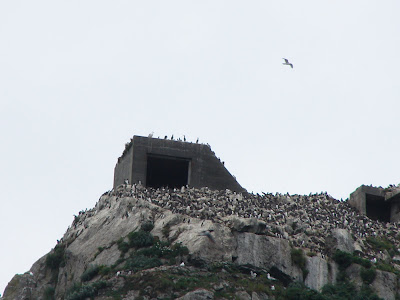 The "birdhouses" in the picture are actually a WWII encampment on Barwell Island. Read this article to see how indeed these remnants of war became a death trap for seabirds.
It was a damp, chilly day in July when I took this picture. I tried to imagine how it would feel to be an American soldier stationed at this remote, frigid, and nearly inaccessible outpost.
 The soldiers' mission was to protect Resurrection Bay from invading Japanese forces. This was a very real concern since the Japanese occupied several nearby islands in the Aleutian Island chain. Our forces managed to keep these islands but the conditions were harsh and the battle was hard fought.
 The Aleutian Island conflict with the Japanese is often forgotten and overlooked but there are some books on the subject as well as some online stories .
Alaska At War 1941 -1945: The Forgotten War Remembered
Forgotten Warriors of the Aleutian Campaign
Thousand Mile War: World War II in Alaska and the Aleutian
 In Anchorage we boarded this train which took us to Seward. We learned lots of fascinating history along the way so naturally I had some of those I-could-write-about-that! moments. Fortunately wisdom told me to leave the Alaska stories to Gary Paulsen.
 Jeannie and Steve were waiting for us in Seward and the 4 of us took a day cruise into Resurrection Bay. Yep we saw whales and walruses and seals and birds. But let's talk about the birds.
 The "birdhouses" in the picture are actually a WWII encampment on Barwell Island. Read this article to see how indeed these remnants of war became a death trap for seabirds.
It was a damp, chilly day in July when I took this picture. I tried to imagine how it would feel to be an American soldier stationed at this remote, frigid, and nearly inaccessible outpost.
 The soldiers' mission was to protect Resurrection Bay from invading Japanese forces. This was a very real concern since the Japanese occupied several nearby islands in the Aleutian Island chain. Our forces managed to keep these islands but the conditions were harsh and the battle was hard fought.
 The Aleutian Island conflict with the Japanese is often forgotten and overlooked but there are some books on the subject as well as some online stories .
Alaska At War 1941 -1945: The Forgotten War Remembered
Forgotten Warriors of the Aleutian Campaign
Thousand Mile War: World War II in Alaska and the Aleutian
Sunday, January 3, 2010
Sunday Series: Heroes & Saints
 The altar that Father Damien built for one of the churches on Molokai, HI.
I decided to make Sundays a day to blog about people who've accomplished great things. I was working on a post about Sister Elizabeth Kenny when I suddenly realized that today is Saint Damien's birthday.
So I'll continue the Sister Kenny post later. It's just as well since I was getting sidetracked into reading her biography all over again.
As for Father Damien, I've certainly blogged about him before and enough is enough, I suppose.
 Father Damien Birthplace Museum which I visited in May 2007
So how about a few crucial dates from Damien's life, a few images, some info about his right hand, and a couple of links?
January 3, 1840 - Born in Tremeloo, Belgium
March 19, 1864 - Arrived in Hawaii
May 10, 1873 - Arrived in leprosy settlement on Molokai
April 15, 1889 - Died of complications related to leprosy
 Aerial photo used with permission by James H. Brocker, author of The Lands of Father Damien. (A fabulous book!)
When Damien died in Hawaii's leprosy settlement, he was buried beside the church in this photo. But his homeland of Belgium wanted his body and in 1936, Franklin Roosevelt agreed to return it.
Then in 1995 when he was beautified (second step on journey to sainthood) the remains of his right hand were returned to Hawaii.
 Damien's coffin now on display at his birthplace museum in Tremeloo, Belgium.
I used to imagine that they simply cut his hand off. But, when I visited the Damien Birthplace Museum, one of my Healing Water experts, Father Paul Macken explained. Damien's body arrived in Belgium in the coffin pictured above. When they opened the coffin, his body disintegrated. So they separated the remains into 11 zinc boxes. One of them contained the bones of his right hand.
Here are Google Image results for Damien - there are some really great ones.
And there is loads and loads of info along with a myriad of pictures at this Damien related blog.
Oh, and DO check out this virtual tour of some Damien sites. Don't be shy. Click on the word Flash to see a 360 degree image. (Unfortunately a few are labeled wrong and you get mules when you wanted to see Damien's birthplace but there are some fabulous images that are worth exploring!)
Wednesday, December 2, 2009
Best of 2009 Blog Challenge: Restaurant Moment
 My best restaurant moment of 2009 isn't a restaurant moment at all. But rather a dining out experience in honor of my sister Joanne's birthday.
It took place on the property where I grew up. Until recently we couldn't visit because someone else lived there. But then the house burned and the landlord removed the outbuildings. What's left is a pond, a creek, woods, and weeds.
 Fortunately Joanne's best childhood friend, Ellen still lives next door and looks out for the place so now we can visit any time.
On this day our brother Ken sent Joanne on a scavenger hunt. Then we headed down to the creek area for a picnic lunch. We knew that our brother, Vernon was providing lunch. I think we expected a picnic blanket and sandwiches.
 What we found was this tent.
 And this table set for Joanne, her sisters, our mom, sisters-in-law, and Ellen.
 Vernon paid attention to the details!
 We were more than astonished!
 And thoroughly delighted.
 He even had music playing under the serving table.
 The food rivaled that of a Highlights Foundation workshop meal.
 The brothers provided towels for wading in the creek.
 So we took off our shoes and went in. We had an incredible time and to round things out, our daddy and our hubbies joined us after lunch for exploring in the woods of my childhood.
 Of course you can't really go home again but this was a lovely attempt.
Thursday, November 26, 2009
THANKSGIVING 101 (For the good things that I've got!)
 Following in the tradition of my friend, Amy, I want to offer a non-traditional thanks.
Today I'm grateful for:
- my 70's era crockpot (because I seldom use it anyway so never mind that it isn't uber cool and doesn't conveniently separate for cleaning.)
- my hardwood floors that need refinishing (because they're not damp dirt floors and there are no holes in them!)
- the roof that needs to be replaced soon. (because it's not a tent in a refugee camp)
- for occasional backpain (because it reminds me to exercise and because in the grand scheme of things, it's nothing, really!)
- for midlist books (because although I don't have millions of readers, I have many who tell me how deeply touched they are by Ann Fay Honeycutt's story) (sequel too!)
- for a smaller royalty check than last time (because four years ago I was still dreaming of publication!)
- fewer speaking engagements (because although I miss the connections and the income, I have more time with my family!)
- for 1/3 of my family gathering today (because the rest are celebrating with their families in other places and anyway 100 plus people is a lot to fix turkey for!)
- that I'm only responsible for broccoli salad and other trivia (because when you're number 6 out of 8 siblings you don't have to be the leader if you don't want to! Thanks Kathleen, my first-born sibling for taking charge and cooking two turkeys!)
Subscribe to:
Posts (Atom)